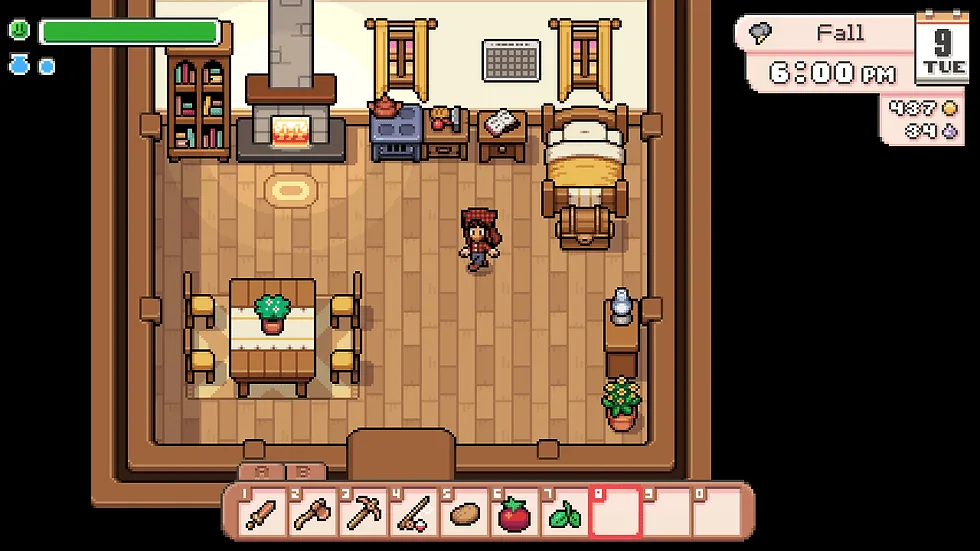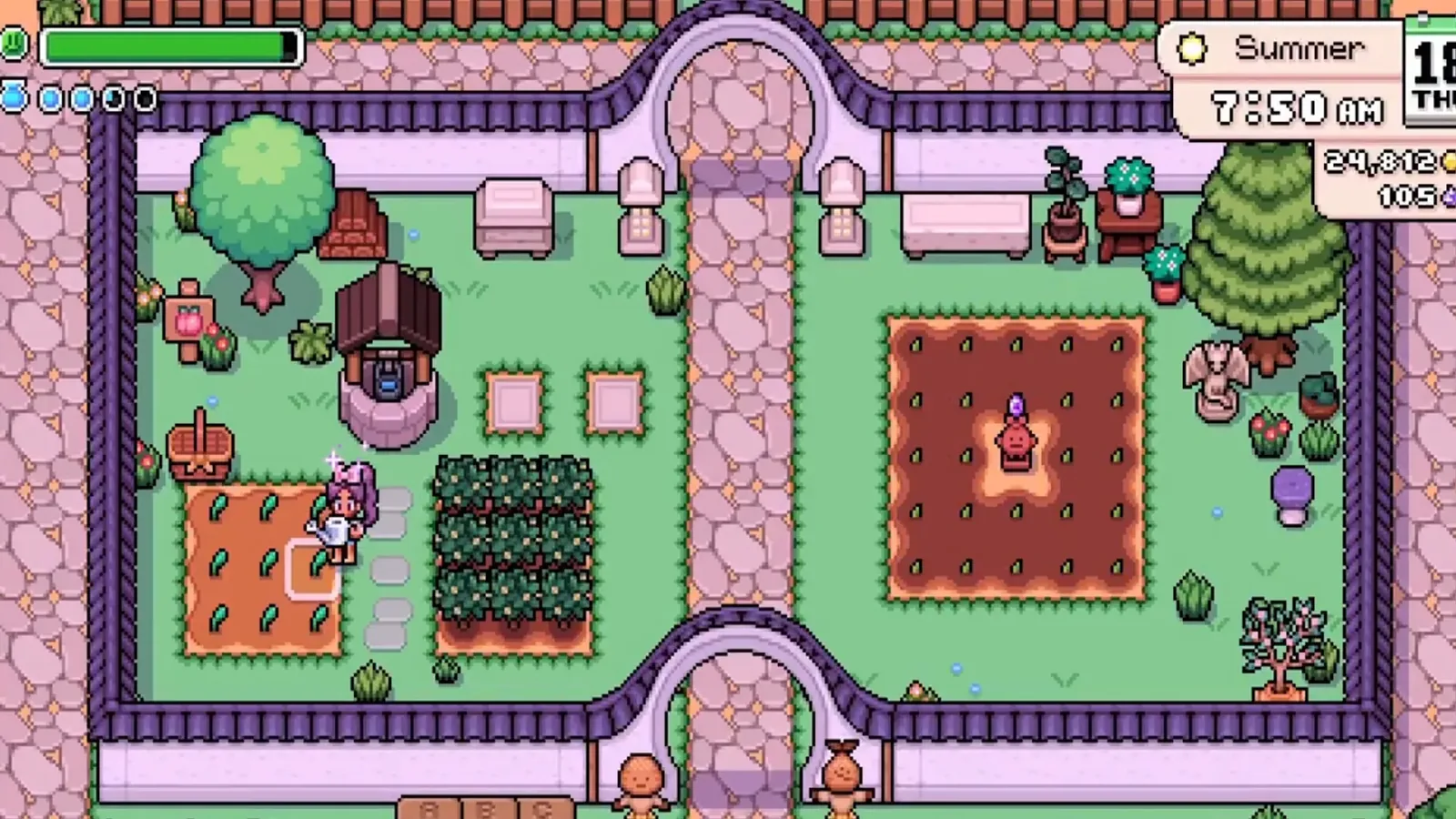
If you are searching for Fields of Mistria sprinklers, the important thing to know is that the game does not call its automatic watering furniture a sprinkler. The system is built around Water Sprite Statues. A normal Water Sprite Statue waters crops within a 2-tile radius, which produces a 5×5 coverage area when the statue is centered correctly. Later, the Big Water Sprites Woodcrafting perk unlocks Large Water Sprite Statues with a 3-tile radius, giving you a 7×7 coverage area.
Both versions need an Essence Stone to keep working. Once powered, they automatically water crops in range each day, turning what begins as a manual watering routine into one of the most useful farm-automation systems in the game.
If you are planning a larger farm, pair this guide with the Fields of Mistria Crops Guide. For broader progression, see the Fields of Mistria 1.0 Guide and Fields of Mistria Map.
Does Fields of Mistria have sprinklers?
Yes in function, but not in name. The closest equivalent to a Stardew Valley-style sprinkler is the Water Sprite Statue. NPC Studio introduced Water Sprite Statues as magical farm automation: place one near crops, power it with an Essence Stone, and it waters crops inside its radius each day.
That naming difference explains why players sometimes search the crafting menus for “sprinkler” and find nothing. Look for Water Sprite Statue or, much later in progression, Large Water Sprite Statue instead.
| Automatic watering item | Radius | Practical coverage | Power source | Progression |
|---|---|---|---|---|
| Water Sprite Statue | 2 tiles | 5×5 | Essence Stone | Standard automation statue |
| Large Water Sprite Statue | 3 tiles | 7×7 | Essence Stone | Big Water Sprites perk |
The statue occupies the center of the layout, so the raw square size is best treated as a planning grid rather than 25 or 49 plantable crop tiles. Design the field around the statue instead of planting a huge field first and trying to squeeze automation into it afterward.
How to unlock the Water Sprite Statue
The normal Water Sprite Statue is not an early-game sprinkler purchased from the General Store. Its recipe is tied to exploration and progression. One route to the statue leads to a special chest in the Beach cave east of the lighthouse after you have progressed far enough to clear the obstruction there.
This means a new farmer should not wait for sprinklers before expanding at all. Early crop fields still rely heavily on the watering can, weather, and manageable field sizes. Treat Water Sprite Statues as a mid-to-late progression upgrade that lets you reclaim morning time once your farm economy and exploration progress are established.
The normal statue has multiple recipe variants. The current automation data lists 10 Refined Stone and 50 Essence as the common core, plus three units of a qualifying additional ingredient depending on the variant. Examples include Ash Mushroom, Purple Mushroom, Temple Flower, Sea Grapes, and Thorn Vine. The recipe takes 30 minutes to craft and requires Woodcrafting level 20.
This is more useful than assuming every statue always requires Ash Mushroom. Older guides often described only one recipe variant, but the current game supports several versions with different third ingredients.
How Water Sprite Statues work
After placing a statue, apply an Essence Stone to charge it. Each powered day automatically waters crops within the statue's radius. You do not need to interact with every crop or activate the statue every morning.
A normal statue reaches two tiles outward in every direction. If you visualize the statue as the center of a grid, that corresponds to a 5×5 square. For efficient layouts, place the statue first, count the two-tile radius, and then till soil around that footprint.
Water Sprite Statues also avoid wasting charges during Inclement and Heavy Inclement Weather days. Because the weather already handles watering, the statue does not need to spend Essence for that day. This makes a long-duration Essence Stone last longer than its nominal number of powered watering days when bad-weather days occur during the charge period.
If you break a charged statue, unused power is not simply lost. Remaining charges can be refunded as Essence Stones corresponding to the unused amount, which makes redesigning a farm less punishing than permanently consuming all stored Essence.
Essence Stones and how long they last
Essence Stones turn Essence into stored charges for magical automation. The Stone Refinery is the central source for crafting them.
| Essence Stone | Stone | Essence | Charge duration |
|---|---|---|---|
| Tiny Essence Stone | 5 | 5 | 1 day |
| Small Essence Stone | 10 | 25 | 5 days |
| Medium Essence Stone | 20 | 50 | 10 days |
| Large Essence Stone | 40 | 100 | 20 days |
| Giant Essence Stone | 80 | 200 | 40 days |
The Giant Essence Stone is worth noting because some older sprinkler guides stop at Large. Current game data includes the Giant version, which can charge a magic tool for 40 days.
For temporary fields or layout testing, Tiny and Small stones are convenient. For a permanent high-value crop block, Medium, Large, or Giant stones reduce maintenance. The best choice is therefore not automatically the largest stone; it depends on whether the crop plot will remain in the same location for most of the season.
How to unlock the Large Water Sprite Statue
The late-game upgrade is the Large Water Sprite Statue. It was added alongside the Big Water Sprites perk and is designed specifically for players who want a wider automatic-watering footprint.
Big Water Sprites is a Tier 5 Woodcrafting perk unlocked at Woodcrafting level 60 and costs 205 Essence at the relevant Dragon Statue. Unlocking the perk gives access to the larger water-sprite designs.
A Large Water Sprite Statue requires:
- 15 Refined Stone
- 75 Essence
- three units of a qualifying additional material, depending on the recipe variant
Current variants use Breath of Flame, Lava Chestnuts, or Flame Pepper as the third ingredient. Crafting takes 30 minutes and requires Woodcrafting level 30 once the recipe has been unlocked through Big Water Sprites.
The key improvement is range: three tiles outward instead of two. That changes the planning grid from 5×5 to 7×7 and makes large, regularly planted crop blocks much easier to automate.
Normal vs Large Water Sprite Statue
The normal statue remains useful even after unlocking the large version. Large statues cost more resources and arrive much later, so replacing every existing statue immediately is rarely necessary.
Use normal statues for smaller seasonal plots, awkward corners, decorative gardens, or crop blocks that already fit a 5×5 layout. Use Large Water Sprite Statues when designing permanent high-volume fields where a 7×7 footprint meaningfully reduces the number of statues and Essence Stones you need to maintain.
For a new farm layout, think in modules. Several carefully spaced watering zones are easier to maintain than one irregular field with uncovered edges. Leave walking lanes between modules so you can harvest, replant, and access the statues without fighting your own crop layout.
Why your sprinkler is not working
If crops remain dry, check the system in this order.
Make sure the item is actually a Water Sprite Statue. Decorative furniture will not automatically water crops just because it resembles magical furniture.
Check the Essence Stone charge. Water Sprite Statues require stored Essence. An empty statue cannot automate watering.
Check the radius. A normal statue only reaches two tiles from its center. A crop outside that radius is not covered simply because it looks visually close.
Do not assume you already own the 7×7 version. The Large Water Sprite Statue is tied to the Big Water Sprites perk. Normal statues remain 5×5 planning grids.
Recheck field geometry after moving the statue. A one-tile placement error can leave an entire outer row outside the watering radius.
Are Water Sprite Statues worth it?
For players who grow only a handful of crops, manual watering can remain perfectly reasonable. The value of Water Sprite Statues increases as your field becomes large enough that watering consumes a meaningful part of every morning.
Automation is especially valuable when you would rather spend that time in the Mines, collecting Museum items, completing quests, visiting villagers, or working on romance. The benefit is therefore not only stamina saved; it is also time returned to the rest of the game.
A sensible progression is to keep early fields modest, unlock one normal Water Sprite Statue, learn how Essence Stone charging feels in practice, and then expand into modular 5×5 watering zones. Much later, when Woodcrafting reaches level 60, Big Water Sprites makes 7×7 zones possible for a more industrial farm layout.
Fields of Mistria sprinkler FAQ
What are sprinklers called in Fields of Mistria?
They are called Water Sprite Statues. The larger late-game version is the Large Water Sprite Statue.
How big is the Water Sprite Statue range?
The normal statue has a 2-tile radius, commonly planned as a 5×5 grid centered on the statue.
Is there a better sprinkler?
Yes. The Large Water Sprite Statue has a 3-tile radius, producing a 7×7 planning grid.
How do I unlock the large sprinkler?
Unlock the Big Water Sprites Tier 5 Woodcrafting perk. It requires Woodcrafting level 60 and costs 205 Essence.
Do sprinklers need power?
Yes. Both Water Sprite Statue types require an Essence Stone. Stone sizes provide different numbers of days of stored power.
What is the longest-lasting Essence Stone?
The current Stone Refinery data includes a Giant Essence Stone, which stores 40 days of charges and requires 80 Stone plus 200 Essence to refine.
Do Water Sprite Statues waste Essence when rain waters crops?
They do not expend Essence on Inclement or Heavy Inclement Weather days, so weather can extend the effective lifetime of a loaded stone.
Related guides
Continue with the Crops Guide to decide what to plant inside your automated fields. If you are still progressing through the world, use the Map and Locations Guide and Mines Unlock Guide. For the major systems added by the full release, see the Fields of Mistria 1.0 Guide.